

A governed path from a submission to a signed grade.
OralIQ runs inside the grading system the campus already uses. Eight parts, in the order they happen.
The submission
The student's own text, file or code, read from Canvas.
The rubric
The instructor's criteria, read from the assignment and never edited. Without one, a generic understanding rubric: explain a choice, predict a change, name the weakest point, connect evidence to claim.
The questions
Four to six, each anchored to a quoted span of the submission and mapped to a criterion. Why this choice. What breaks if it changes. Recall is never scored.
Essay 1, understanding checkQuestion 2 of 5"The pilot's 80 percent target was chosen so one space per block stays open."
quoted from your paragraph 3
Why 80 and not 90?
Listening0:42 leftYour words appear here as you speak.
I'm doneRequest an accommodationRecorded with your consent. No face, no voiceprint. Kept one year.
An illustration of the student's screen. SYNTHETIC: the essay, the course and the question are fixtures. The check
Spoken, opened from the assignment or a module item. Consent first. One question at a time, 90 seconds an answer, one follow-up. Typed is the Section 504 accommodation.
Essay 1, understanding checkBefore question 1Before we start.
- This check records your voice. No face, no voiceprint.
- Your recording and transcript are filed on your submission and kept one year.
- You can type instead, and that is labeled on the record.
I consent, startType insteadA drawing of the consent screen. SYNTHETIC: the course and the assignment are fixtures. The proposal
Per-criterion points, each with a quoted transcript span and one line of reason, from a scorer that takes no instruction from the student. A second scorer gives an agreement mark.
Essay 1, proposalProvisional17 / 2085 percent
- Thesis and claim4 of 5
- Evidence5 of 5
- Counterargument3 of 5
- Choice explained5 of 5
Two scorers agree
AcceptEditRejectNot in the gradebook until you select, publish and post.
A drawing of the proposal's glance layer. SYNTHETIC: the essay, the rubric and the points are fixtures. The signature
The instructor sees the proposal in SpeedGrader, accepts, edits or rejects it, then selects, publishes and posts. Whether the transcript was opened is logged.
The record
Transcript, recording, rubric mapping, timestamps, the model and its version, and the instructor's action. Filed on the submission and kept one year, with a legal hold on any request.
Essay 1, recordFiled on the submission- Consentgiven, 2:30 pm
- Questions5, one follow-up
- Transcriptoraliq-transcript.txt
- Recordingoraliq-check.wav, 6:10
- Rubric mapping4 criteria, quoted spans
- Instructor's actionselected, published, posted
Kept one year, with a legal hold on any request. The student can replay, read and contest.
A drawing of the record. SYNTHETIC: the files are the probe fixture's. The paper
Your existing Canvas contract and data agreement, the proctoring or detection line the order lands on, a consent block, and no biometric identifiers.
The proposal reads in three layers. Each is a legitimate way to grade.
- seconds
The glance
The proposed total as points and percent, the per-criterion points, whether the two scorers agree, and the accept, edit and reject actions.
- half a minute
The summary
Shows understanding of, and still lacks, as two short lists, each tied to a criterion and quoting the student's words.
- minutes
The evidence
The transcript cut into anchored spans per criterion, and the recording.
The instructor signs in three steps.
- 01
Select
She picks the proposal, or her own edit of it.
- 02
Publish
Canvas writes the score to the gradebook. The student still cannot see it.
- 03
Post
The student sees the grade. Module locks and the course total read it only now.
Until the first step, the proposal has not touched the gradebook. Between the second and the third, the grade is in the gradebook and hidden from the student.
What it looks like on Canvas's own pages.
Three captures from the open-source Canvas, run on one laptop. Every submission, student and course is a fixture.
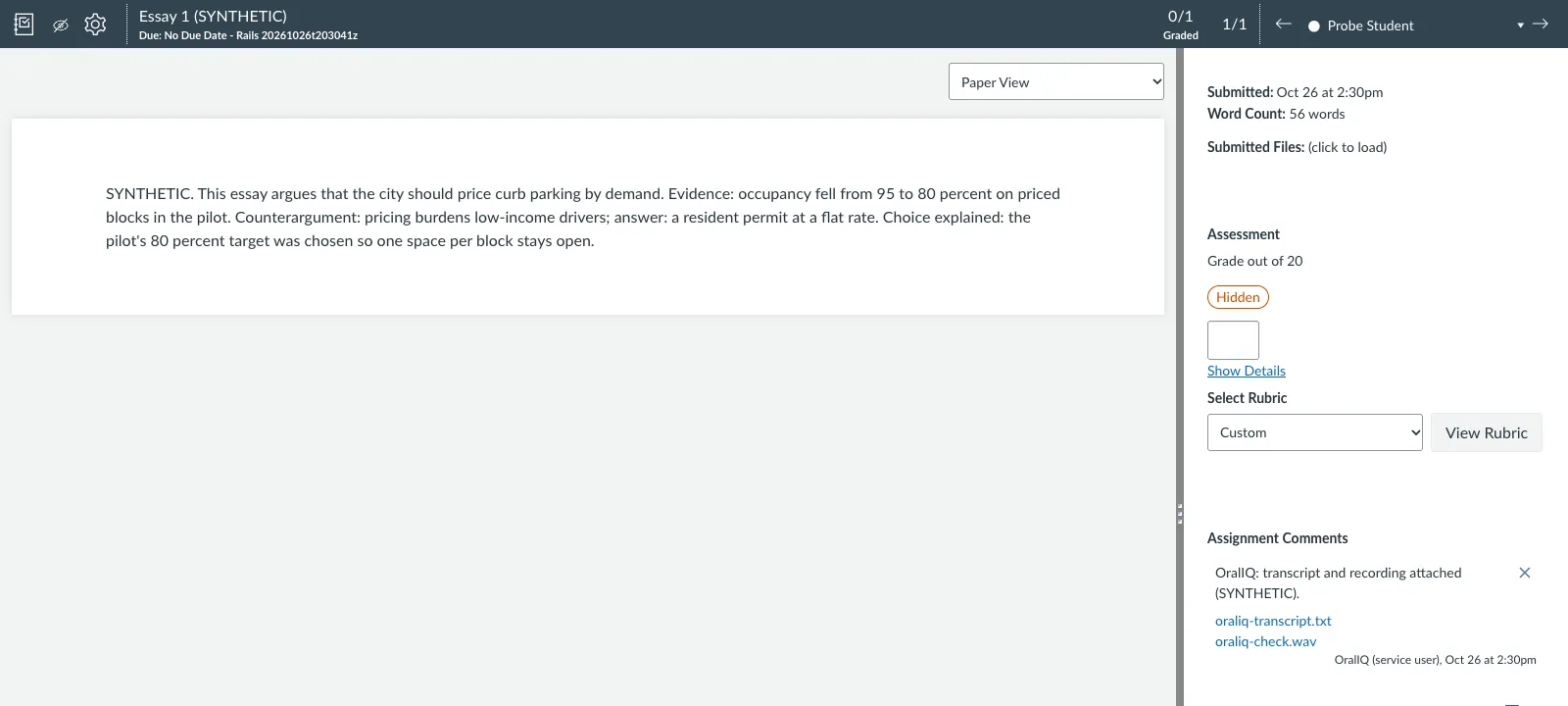
SYNTHETIC. SpeedGrader before the instructor acts: the grade hidden, the rubric attached, the transcript and recording on the submission. 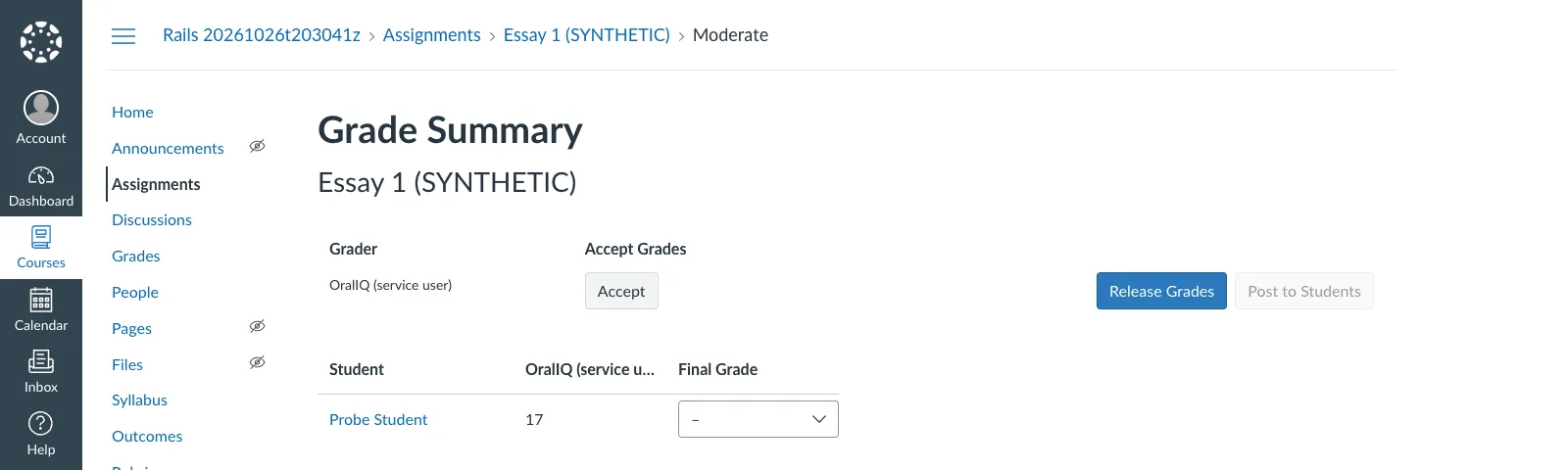
SYNTHETIC. The moderation page: a provisional 17, the final grade empty until the instructor releases and posts. 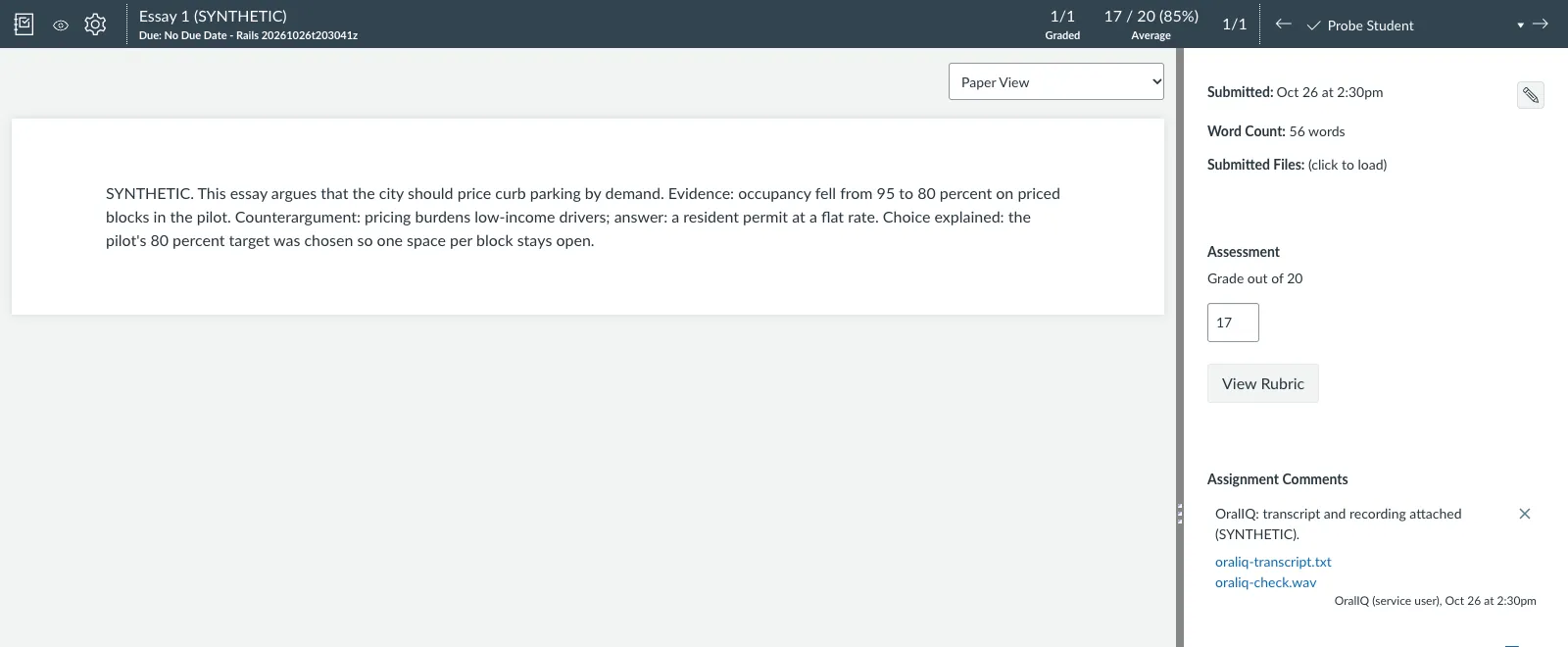
SYNTHETIC. After she selected, published and posted: 17 of 20, written by Canvas's own motion, not by the tool.
What OralIQ never does.
- It never says who wrote the work. No authorship verdict, no AI-use probability, no sentence that reads "the student wrote this".
- It is not a detector, it is not a plagiarism check, and it is not proctoring: no face, no voiceprint, no lockdown browser.
- It never posts a grade. It proposes, and a person signs.
- It never replaces a human examiner, at any level, from the weekly paper to the capstone committee. It runs beside them as a second, documented examiner.
- It never scores fluency, accent or pace. The rubric is the instructor's, and it carries no such criterion.
Two columns, both the instructor's.
The artifact grade and the understanding score sit side by side. What each pairing means is decided by the instructor's own policy, and OralIQ draws no inference about the cause.
Where a campus opens a conduct case, the conclusion is the integrity office's under its own policy, never the product's.
See it on one of your own assignments.
A pilot runs on one course for one term. The instructor signs every score.